

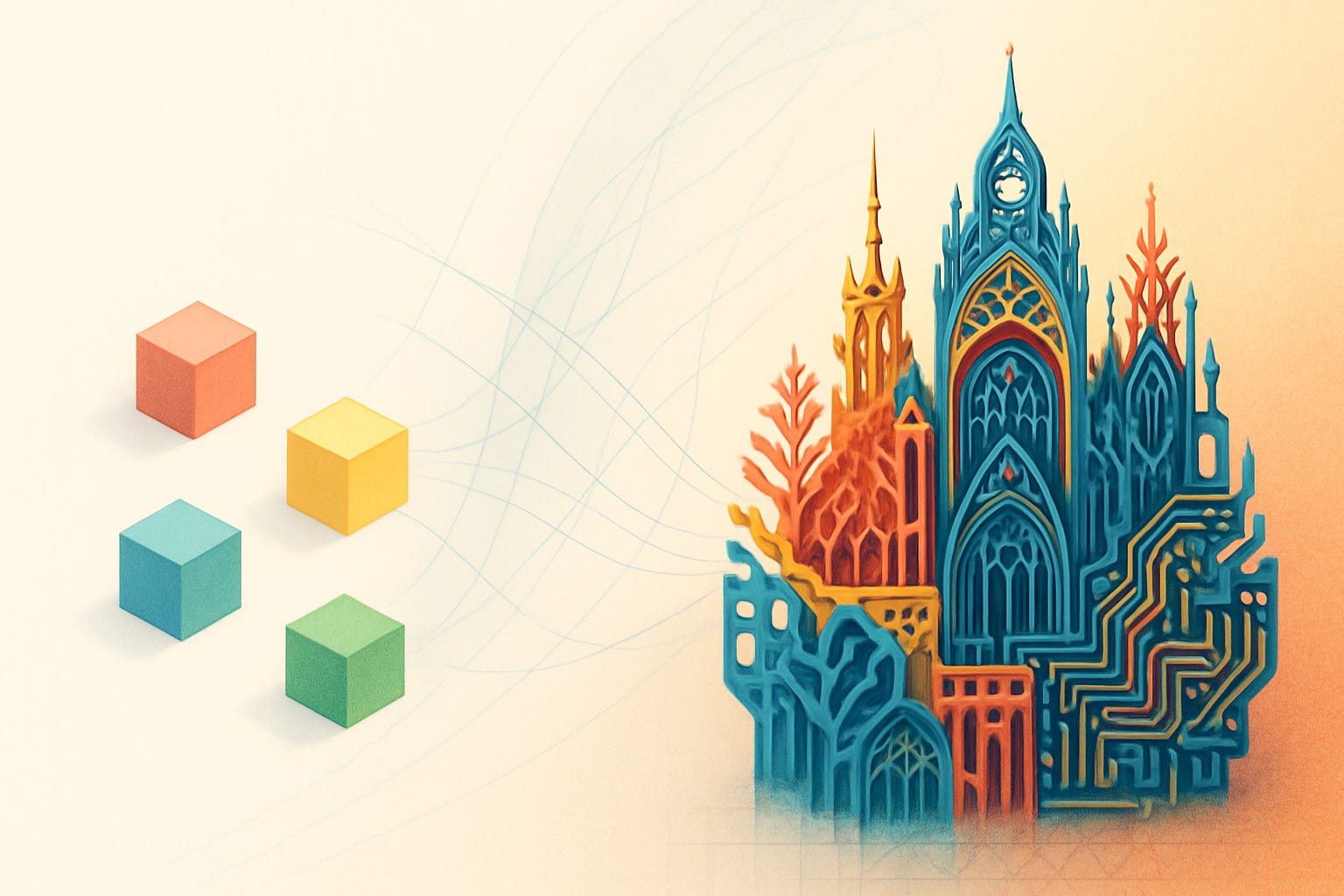
We can also examine how if we begin with some small set of concepts, we might end up with fairly complex phenomena. This is an attempt to apply the same principle from the previous chapter in reverse.
Language
The English alphabet has 26 letters, A through Z. These letters can be arranged in lot of different ways to create words. Some estimates say that language has ~1 million words in total, with ~170k words in current use. (Sources: Merriam-Webster, EFEnglish Live). Now imagine the number of meaningful sentences you can form with these words and some rules of grammar, orders of magnitudes larger. All other languages also scale in a similar fashion.
Primary Colors
Take a step into any art supply store and you’ll be overwhelmed by the rainbow of paint tubes lining the shelves - hundreds of distinct colors, each with its own name and character. Yet this entire spectrum emerges from three primary colors - red, blue, yellow.
These three foundational hues, when mixed in different proportions, generate the full palette that artists use to capture sunsets, portraits, landscapes, and abstract expressions. Add white and black to the mix, and suddenly you have access to infinite gradations of tone and shade. The Mona Lisa’s subtle skin tones, Van Gogh’s vibrant sunflowers, Picasso’s blue period - all constructed from these same three starting points.
Digital displays use a similar principle with red, green, and blue light (RGB) to create every image on your screen. The photograph you took yesterday, the movie you watched last night, the complex data visualizations in scientific papers \- all composed from combinations of these three basic building blocks of light.
Chess
The game of chess operates on surprisingly simple foundations. Six types of pieces, each with straightforward movement rules, placed on an 8x8 grid. A pawn moves forward one square, a rook moves in straight lines, a bishop moves diagonally. These basic constraints seem almost childlike in their simplicity.
Yet from these humble beginnings emerges a game of staggering complexity. Mathematicians estimate there are approximately 10^120 possible chess games - a number so large it exceeds the estimated number of atoms in the observable universe. Every chess match played throughout history represents a unique path through this vast landscape of possibilities.
This explosion of complexity from simple rules has fascinated not just players but also computer scientists and mathematicians. The same principle that governs chess - simple rules creating infinite variation - appears throughout nature and human systems.
Coral Reefs
Perhaps the most dramatic example comes from the ocean depths. The Great Barrier Reef stretches for 1,400 miles along Australia’s coast—so massive it’s visible from space. This vast underwater metropolis, teeming with thousands of species and intricate structures, began with something remarkably simple: a single coral polyp.
A coral polyp is a tiny organism, barely a few millimeters across—a soft-bodied creature that looks like a miniature sea anemone. Yet this simple animal possesses an extraordinary capability: it secretes calcium carbonate, building a hard limestone skeleton around itself for protection.
Here’s where “something to everything” unfolds across time. That single polyp reproduces, creating genetically identical clones. Each new polyp builds its own skeleton atop the previous generation’s foundation. Slowly, over thousands of years, these individual efforts compound. One polyp becomes a colony. Colonies merge into formations. Formations expand into reef systems.
The Great Barrier Reef we see today—with its massive bommies rising from the ocean floor, its intricate caves and channels, its vast biodiversity—emerged from millions of tiny polyps each following the same simple process: attach, secrete calcium carbonate, reproduce, repeat. Simple organism plus simple process plus vast time equals one of Earth’s most spectacular creations.
What took the Grand Canyon millions of years through erosion, coral reefs achieved through construction—but the principle remains identical: simple elements, simple rules, extraordinary time, breathtaking result.
The Pattern
What connects these examples - from language to art to games to life itself - is a fundamental principle about how complexity emerges from simplicity. In each case, a small set of foundational elements, combined with simple rules for interaction, generates infinite possibility.
The power lies not in the individual building blocks, but in their potential for combination and recombination. Three colors become millions of hues. 32 pieces on a 64 square board creates an enormous canvas of games that people enjoy. Coral polyps become vast reef ecosystems.
It’s a window into understanding how our universe operates at every scale. The same pattern appears whether we’re looking at how atoms combine to form molecules, how simple computer code creates sophisticated software, or how basic social norms evolve into complex civilizations.
The Rules
But here’s another observation that emerges from these examples: simple components alone don’t create meaningful complexity.
Take the 26 letters of the alphabet. Arrange them randomly and you get gibberish: “xqzptlmwk.” The letters are there, but without rules governing their combination, they produce noise, not language. It’s only when we apply the constraints of grammar, phonetics, and meaning that those same 26 letters become Shakespeare, scientific papers, or love letters. Similarly, in chess without movement rules, the pieces are just carved wood on a checkered board. The constraints on how each piece can move create the strategic depth that has captivated minds for centuries. Mix primary colors randomly and you very likely will end up getting something that resembles mud. Understanding color theory—the rules of complementary colors, saturation, and value—enables artists to create masterpieces. Lastly, not every calcium carbonate structure becomes a thriving reef. The polyps must attach to suitable substrate, maintain proper depth for sunlight, withstand currents—environmental rules that determine which structures flourish and which crumble.
What we’re observing is a secondary principle that works alongside “everything from something”: Contextual rules determine how “everything” emerges from the “somethings.”
The rules aren’t arbitrary restrictions—they’re channeling mechanisms that guide simple components into meaningful patterns rather than random noise. Without gravity, atoms wouldn’t form stars. Without grammar, letters wouldn’t form language. Without the laws of chemistry, molecules wouldn’t form life. Complexity doesn’t just emerge from simple components. It emerges from simple components operating under constraints that filter infinite possibilities into meaningful patterns. The universe gives us building blocks. The rules dictate what gets built.
When we start with “something”, however minimal, combined with contextual rules, it opens the door to “everything”.
Compendium of Working Principles
2. When we start with “something”, however minimal, combined with contextual rules, it opens the door to “everything”.
1. Everything from something, a pattern hidden in plain sight, seems almost universal!