

We analyze how all phenomena—from optical illusions, natural formations and mathematical patterns, emerge from simple foundational ideas. We generalize this to hypothesize that any knowledge system including all existence has hierarchy built into it, with intricate systems arising from basic building blocks.
The Dress
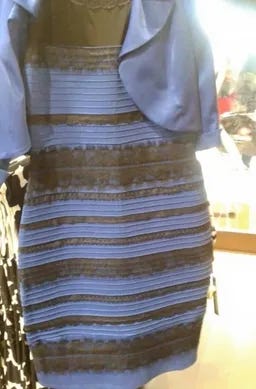
Back in 2015, "The Dress" went viral. It is time for a re-visit.
Source: Wikipedia
What colors do you see in this picture?
🎨🎨🎨🎨🎨🎨
Posts about "The Dress" made its way through facebook, tumblr, twitter, buzzfeed. People reported it as either white + gold or as blue + black. Spouses, siblings, children, parents, friends, co-workers were firmly divided into these two camps.
Naturally, the question then is why do you perceive the same dress differently from others?
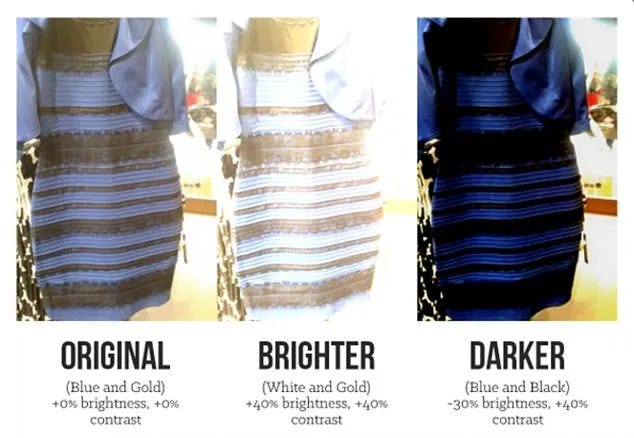
The visual perception of any image can vary among individuals due to differences in color perception, and chromatic adaptation according to neuroscientists Bevil Conway and Jay Neitz. Human eyes can get the same inputs from the external world, but they can be processed and interpreted differently in the brain, leading to variations in how individuals see the same image. In this case, the implicit assumptions around the lighting conditions under which the dress is viewed play a crucial role. Here is a direct quote from Conway as reported by Wired - "Your visual system is looking at this thing, and you're trying to discount the chromatic bias of the daylight axis ... people either discount the blue side, in which case they end up seeing white and gold, or discount the gold side, in which case they end up with blue and black."
This image of the dress under different lighting conditions clarifies the idea.
Source: Dailymail
What just happened in your brain reveals something profound about reality itself. Your visual system took simple light wavelengths and, through a few basic processing rules, created a complex perceptual experience that differs dramatically from the person next to you!
Dung Beetles: When Simple Meets Stellar
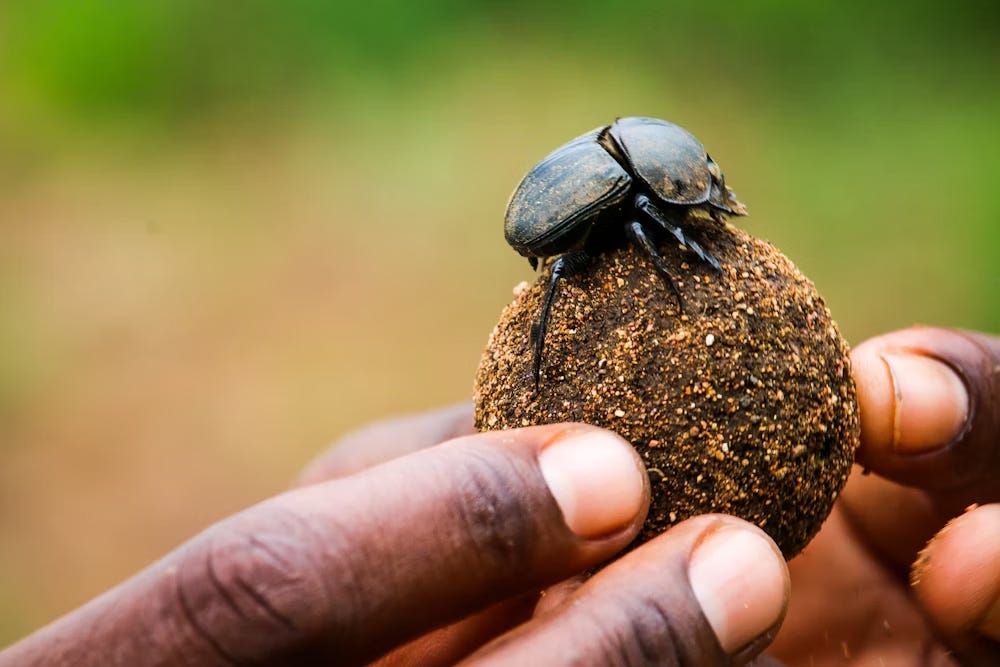
This same principle—simple mechanisms creating extraordinary complexity— keeps showing up in the most unexpected places. Consider a creature you'd never suspect of cosmic sophistication: the dung beetle.
Source: Unsplash
Dung beetles, as their name suggests, feed on the dung of larger animals. Using their keen sense of smell, they locate fresh dung, form it into a ball, and roll it away to bury as food for their offspring. But here's where it gets interesting: some species of dung beetles can navigate in nearly straight lines away from the dung pile, regardless of obstacles or terrain.
This ability raised a compelling question among scientists: How do dung beetles maintain such precise navigation under seemingly unpredictable conditions?
Initial hypotheses suggested that dung beetles might use the sun or moon as navigational aids, much like ancient sailors. To test this, scientists conducted a series of clever experiments:
They observed the beetles' behavior during the day and on moonlit nights, confirming their ability to navigate straight lines.
They then tested the beetles on cloudy days and moonless nights, expecting their navigation to falter. Surprisingly, the beetles maintained their remarkable navigational skills.
In a crucial experiment, researchers fitted tiny visors to the beetles' heads, obscuring their upward vision. With these "hats" on, the beetles' straight-line navigation failed, indicating they were indeed using visual cues from the sky.
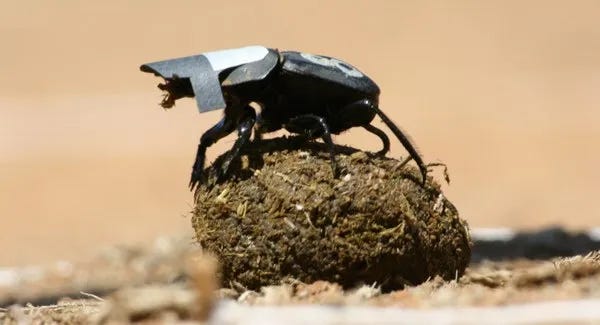
Photo by Marcus Byrne
But if not the sun or moon, what celestial cue could the beetles be using? Any guesses?
⁉️⁉️⁉️⁉️⁉️⁉️
The breakthrough came when scientists from Sweden and South Africa discovered that dung beetles possess a remarkable sensitivity to the Milky Way. In controlled experiments using a planetarium, they found:
When the night sky was visible, beetles oriented themselves along the Milky Way's band of light.
When researchers projected an artificial Milky Way in the planetarium, the beetles adjusted their orientation accordingly.
Without any celestial cues, the beetles' navigation became random.
This discovery placed dung beetles among only a handful of species known to orient themselves using the Milky Way, a list that includes humans, seals, and birds.
Here's what's truly remarkable: this sophisticated celestial navigation system emerges from just a few simple light-detecting mechanisms in the beetle's brain. Basic inputs, simple processing rules, extraordinary output.
Grand Canyon: When Time Meets Simplicity
If insects can achieve the extraordinary through simple means, imagine what happens when simple forces have millions of years to work their magic.
Source: Unsplash
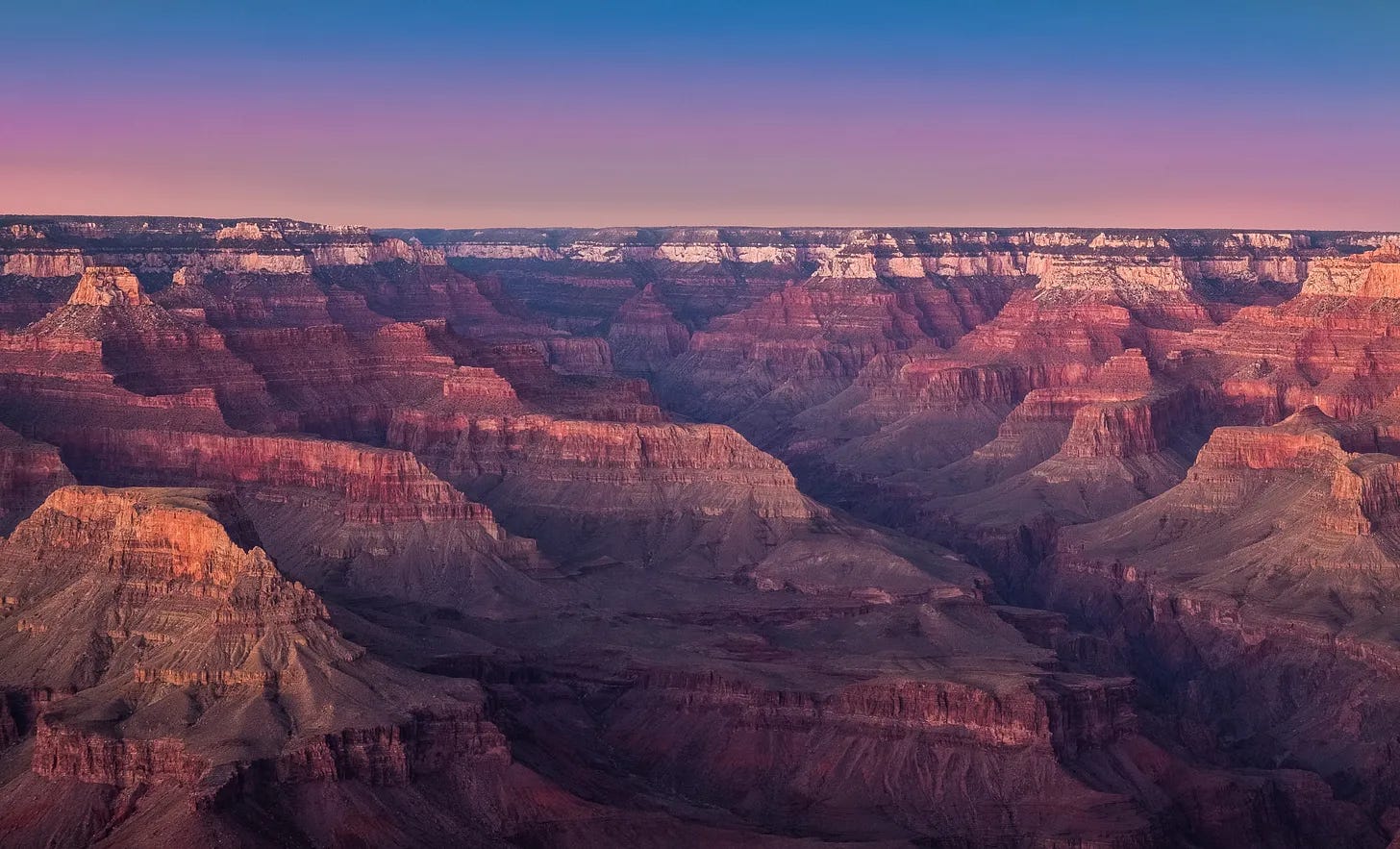
The Grand Canyon is cool not just for its staggering depth, plunging down about a mile into the Earth's crust, but also for its impressive width, spanning up to 18 miles at its widest point. This expansive canyon exposes intricate rock layers, showcases a festival of colors and is truly a sight to behold!
For the casual visitor, a question that often comes up is - how did this come to be?
If we trace back the explanations various cultures had for the formation of canyons they are often rooted in mythologies or religious beliefs. For example, in Ancient Greek and Roman beliefs, explanations for geological features were often tied to the actions of gods.
What do you think happened here?
🤔🤔🤔🤔🤔
Reality is both simpler and more magnificent than any myth. Take four basic forces: wind, water, freezing, and expansion. Each one, individually, seems almost gentle. A breeze barely moves a feather. Water flows around the smallest pebble. Ice forms quietly in winter, melts peacefully in spring.
But combine these simple forces with time—not just years, but millions of years—and something extraordinary emerges. Each tiny action compounds. Every grain of sand moved by wind, every crack widened by freezing water, every fragment carried away by the Colorado River—these minuscule changes accumulate into one of Earth's most spectacular creations.
In the case of the Grand Canyon, it was formed over millions of years through tectonic movements and the erosive actions of the Colorado River, gradually carving through layers of rock to create the geological spectacle we see today.
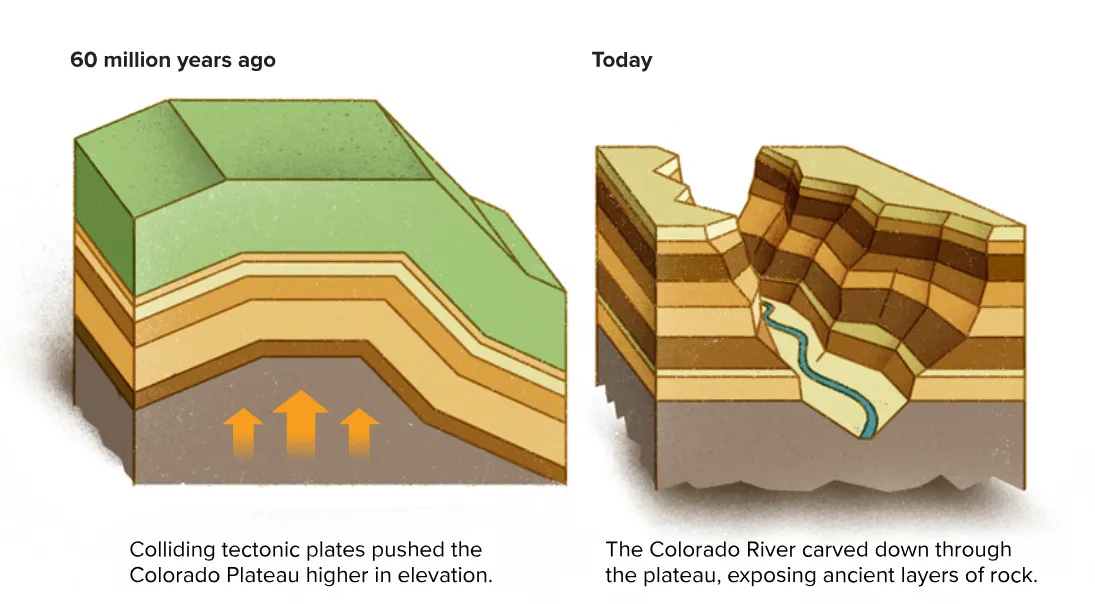
Source: National Park Service, Knowable Magazine
Simple forces + Time = Geological marvel. The same equation that carved the Grand Canyon shapes coastlines, creates mountains, and sculpts every landscape on Earth.
Numbers: The Hidden Architecture
This pattern of complexity emerging from simplicity isn't limited to the physical world. It's built into the very fabric of mathematics itself.
Let's explore this with something beautifully simple: rational numbers—any number that can be expressed as one whole number divided by another.
Think about dividing 1 by 3. You get 0.333333... with the 3 repeating forever. Divide 1 by 7, and you get 0.142857142857... with the sequence 142857 repeating endlessly.
Here's an interesting observation: no matter what rational number you choose, when you convert it to decimal form, it will either terminate (like 1/4 = 0.25) or repeat in a pattern (like 1/3 = 0.333...). Always. Without exception.
Why? The answer lies in a beautifully simple insight about remainders. When you perform long division, there are only so many possible remainders you can get. For any number n, you can have at most n-1 different remainders. Once you've used them all up, the pattern must repeat.
From this one simple rule—the limited number of possible remainders—emerges an ironclad mathematical law that governs every rational number in existence.
The Lego Principle
Take a step back and look at what we've discovered:
The Dress: Simple neural processing rules create the complexity of subjective experience and human disagreement.
Dung beetles: Basic light detection mechanisms enable sophisticated celestial navigation.
Grand Canyon: Elementary geological forces plus time create breathtaking natural architecture.
Rational numbers: Simple division rules can explain a slice of mathematical patterns.
In each case, we see the same fundamental principle at work: complexity emerging from simplicity.
Think about the largest Lego creation you've ever built. Maybe it had 100 pieces, maybe 1,000. The largest Lego installation in the world is the Millyard Project—built with 3 million Lego bricks. It's a detailed replica of Manchester, New Hampshire's historic industrial district, complete with buildings, streets, and intricate architectural details. Whether you're building a simple car or a massive cityscape, every Lego creation follows the same principle. Complex structures emerge from simple, standardized building blocks. A single 2x4 brick might seem insignificant, but combine enough of them with vision and time, and you can build virtually anything.
This is the lego principle at work!
Knowledge as Lego Megastructures
Knowledge works exactly the same way. Every piece of knowledge you have follows the same pattern.
Take something simple: a tree. You know what a tree is, but break it down: it's a woody plant with a trunk, branches, leaves. What's woody? Wood is fibrous tissue made of cellulose. What's cellulose? A molecule made of glucose units. What's glucose? Carbon, hydrogen, oxygen atoms composed in a particular manner. What are atoms? Protons, neutrons, electrons masdhed together. And so on. Keep asking "what is that made of?" and you eventually hit the bedrock foundational concepts that can't be broken down further. These are our knowledge equivalent of unit Lego bricks.
Consider Mozart's Twelve variations for the 18th century French children's melody "Ah! vous dirai-je, maman". This is the popular tune behind the nursery rhyme "Twinkle Twinkle Little Star". This 12-minute piece emerges from — five notes which Mozart composed using various techniques: ornamentation, rhythmic shifts, key changes. Simple elements, clear rules, and boundless recombination prove that the expressive possibilities prove limitless.
Consider Aesop's "Tortoise and the Hare". It emerges from just three axioms — speed exists on a spectrum, effort can be sustained or intermittent, distance is finite. From these building blocks, the fable constructs an interesting narrative by assigning maximum speed to the Hare, minimum speed to the Tortoise, inconsistent effort to one, consistent effort to the other. The story then centers on a simple equation: Distance = Speed × Time, with one elegant twist—the introduction of sleep as a variable. The Hare's superior speed becomes irrelevant when multiplied by zero (sleep time), while the Tortoise's steady pace multiplied by continuous effort enables it to win. In about 200 words of original text, he encoded human wisdom that explains every business comeback, every underdog story, every late-bloomer success.
Every knowledge base — whether it's Wikipedia, a story, or a body of science — begins with humble building blocks and follows the same hierarchical path towards higher order organization. At the same time all knowledge systems share an identical atomic structure:
Entities are the things we can name and discuss—Frodo, gravity, the concept of justice, the number seven.
Properties describe what these entities are like—Frodo is brave, gravity has force, justice demands fairness.
Relationships connect entities to each other—Frodo carries the Ring, Earth orbits the Sun, wisdom follows from experience.
Facts capture specific instances—Gandalf is a wizard, Paris sits in France, two plus two equals four.
Rules govern how everything operates—magic corrupts those who use it, planets follow elliptical orbits, actions have consequences.
These five components are the cognitive equivalent of atoms — simple, fundamental, universal. And from these five simple components, every sophisticated knowledge system emerges.
Everything from something.
Reality
Knowledge bases map to reality to varying degrees. Our understanding maps to actual existence with varying degrees of fidelity—sometimes precisely, sometimes approximately, sometimes metaphorically.
Mapping of knowledge to reality across different domains
High Fidelity: When we describe water as H₂O, we're capturing something fundamentally true about reality's structure. The hierarchical relationship—molecules composed of atoms, atoms of particles—reflects actual organizational principles in nature.
Approximate Fidelity: When we say, "the sun rises," we're using imperfect language to describe a real phenomenon. The hierarchy of our description (sun, horizon, earth, motion) maps to actual relationships, even though our perspective creates the illusion.
Metaphorical Fidelity: When we describe DNA as "the blueprint of life," we're using architectural metaphors to capture genuine hierarchical relationships—genes to proteins to cellular functions to organisms—even though DNA doesn't literally blueprint anything.
If our knowledge consistently demonstrates hierarchical structure, and this knowledge maps to reality with meaningful accuracy, then reality itself likely exhibits the same everything from something, organization principle. This isn't just philosophical speculation— we empirically observe it too.
Physical Hierarchy: Quarks → Protons/Neutrons → Atoms → Molecules → Compounds → Materials → Objects → Systems → Planetary Bodies → Solar Systems → Galaxies
Biological Hierarchy: DNA → Proteins → Organelles → Cells → Tissues → Organs → Organisms → Populations → Ecosystems → Biosphere
Social Hierarchy: Individual Decisions → Personal Relationships → Family Units → Communities → Institutions → Societies → Civilizations → Global Systems
Continuity Through Time and Matter
The hierarchical principle applies to organization through —it governs how reality unfolds through time and transforms across different states of matter.
Temporal Continuity: Every present moment emerges from the organization of previous moments. The complex state of today builds from the simpler interactions of yesterday, which built from even simpler initial conditions. Time itself exhibits hierarchical structure—microseconds compose seconds compose hours compose days compose lifetimes compose historical epochs.
Material Continuity: As matter transitions between states (solid to liquid to gas to plasma), the hierarchical relationships persist but reorganize. Ice crystals, liquid water, and water vapor all maintain the fundamental H₂O relationship while expressing different emergent properties at higher organizational levels.
The Causal Transform
This hierarchical principle, when viewed through the lens of time, becomes the principle of causality itself. Cause and effect are simply hierarchical relationships expressed temporally:
Simple causes operating according to basic rules create complex effects. A butterfly's wing movements (simple atmospheric disturbance) can contribute to hurricane formation (complex weather system) through cascading hierarchical interactions across multiple scales of organization.
Every effect becomes a cause for subsequent effects, creating hierarchical chains of causation that build complexity over time.
A Universal Pattern
The beetles' navigation system? Built from simple light-detection mechanisms combining in sophisticated ways. The Grand Canyon? Simple geological forces operating across vast time scales. Your own consciousness? Billions of simple neurons firing in complex patterns.
Reality operates like a cosmic Lego set. At every scale, from quantum particles to galaxies, from chemical reactions to human societies, we find the same principle: simple building blocks, following basic rules, creating infinite complexity.
This perspective can change how one approaches problems. Instead of being overwhelmed by complexity, one can start looking for the underlying patterns. It’s how scientists decode the mysteries of quantum mechanics. It’s how engineers design robust systems. It’s how evolution creates the stunning diversity of life.
Everything from something, a pattern hidden in plain sight, seems almost universal!
Compendium of Working Principles
1. Everything from something, a pattern hidden in plain sight, seems almost universal!